
PLAYER SPOTLIGHT · OFF DAY
Justin Champagnie Is Doing the Work Between the Highlights
The dunk over Caleb Wilson gets the replay. The 14 rebounds, four assists and zero turnovers explain why Champagnie mattered in Washington’s win at Chicago.
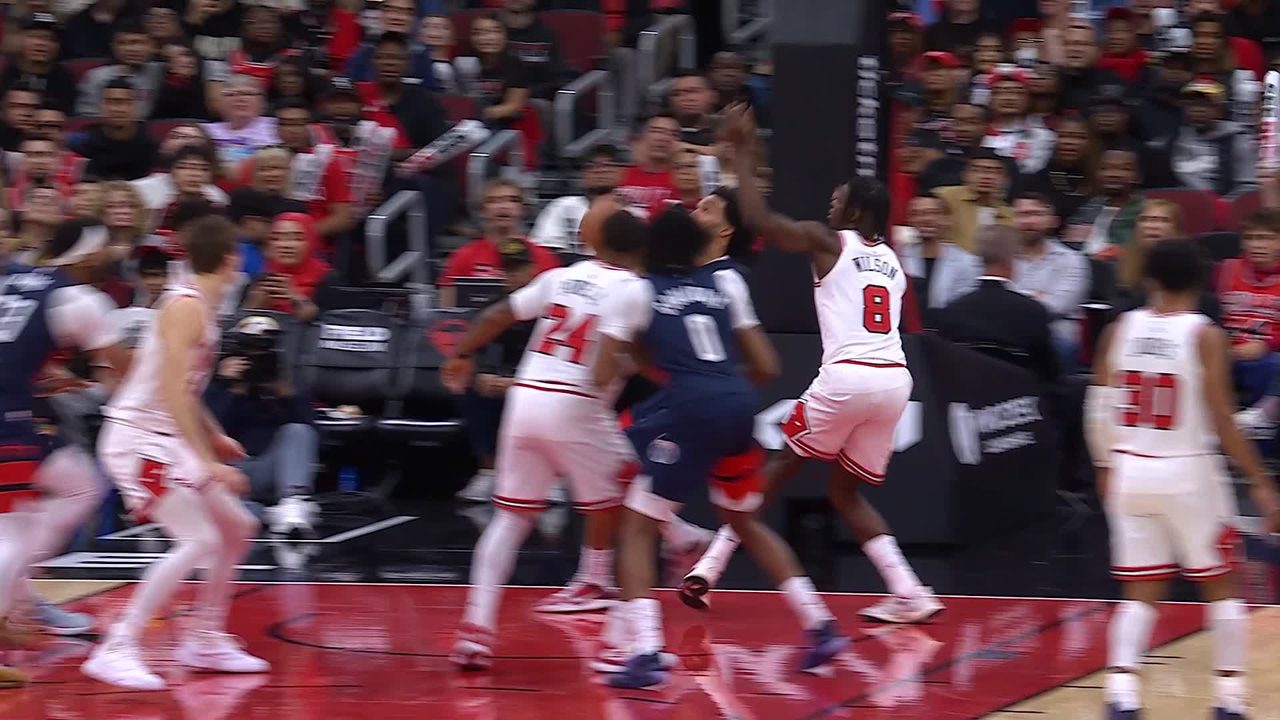
Justin Champagnie gave Wizards fans the clip they wanted in Chicago: a strong finish over Caleb Wilson. But the dunk is the entry point, not the whole case. Washington needed someone to collect misses, connect the offense and contribute without taking over the ball. Champagnie did all of that in a 124–120 road win on October 24.
His line tells the story: 11 points, 14 rebounds, four assists and no turnovers in 26:13. The highlight is memorable. So is the work that made his minutes useful before and after it.
START WITH THE DUNK
With 4:23 left in the fourth quarter, Champagnie finished a George-assisted dunk that put Washington ahead 112–96. NBA.com has the individual play in an 18-second clip, linked directly beneath the official highlights embed. Watch that standalone clip for the finish over Wilson; the full-game video provides the surrounding game context.
It was a satisfying finish, especially on a night Wilson put up 30 points and 14 rebounds of his own. It was not the possession that ended the contest. Chicago kept coming, and Washington eventually won by four. Enjoy the highlight without turning it into a claim that the rest of the fourth quarter was comfortable.
That is also the right way to assess Champagnie. Appreciate the athletic play, then look at how often he helped the next possession belong to Washington.
FOURTEEN REBOUNDS ARE THE MAIN ARGUMENT
Champagnie collected 11 defensive rebounds and three offensive rebounds. A defensive miss is not a stop until someone secures the ball. An offensive rebound can turn an empty trip into another chance. His contribution addressed a problem that had been painfully clear one night earlier against Toronto.
The Raptors had grabbed 19 offensive rebounds in Washington’s loss. Chicago finished with nine against the Wizards. Champagnie cannot take individual credit for that entire team improvement, but his 11 defensive boards were substantial, concrete work inside the better result.
The offensive rebounds matter for a different reason. On a team with Young and Davis creating advantages, a supporting player does not need to manufacture every shot. Pursuing an available second chance is another way to contribute. The qualification is floor balance: chasing a rebound still has to fit the team’s plan for getting back. Effort is most valuable when it stays connected to the other four players.
FOUR ASSISTS. ZERO GIVEAWAYS.
The passing belongs next to the rebounding, not in a footnote. Four assists without a turnover is a useful line for a player whose value does not depend on running the whole offense. It shows a productive night moving possessions forward without adding a giveaway to the box score.
That is different from claiming every pass was perfect or that a zero-turnover night proves permanent decision-making mastery. The encouraging question is practical: can Champagnie keep being an available receiver, make the useful next pass and finish when the advantage reaches him?
His Chicago shooting was efficient: 4-for-8 overall, 1-for-3 from three and 2-for-2 at the foul line. Washington did not need a huge scoring volume from him. It needed a supporting role performed well enough that the main action could keep working.
THE PLUS-18 NEEDS CONTEXT
Champagnie had Washington’s best individual plus-minus at plus-18. The Wizards outscored Chicago by 18 during his minutes. That is worth noticing, but it is a lineup result influenced by teammates, opponents, substitutions and shooting.
It is not proof that every possession succeeded because of him, or that the coach should build every closing group around one number. Start with the observable contributions: 14 rebounds, four assists, no turnovers and an efficient scoring night. Use the plus-minus as a reason to look more closely at those minutes, not as a substitute for doing that work.
THREE GAMES, A USEFUL PATTERN TO FOLLOW
The Stats Lab’s current-season game log shows Champagnie with eight points and eight rebounds against Milwaukee, eight points and six rebounds against Toronto, then 11 points and 14 rebounds against Chicago. That is 28 rebounds across three games.
Three appearances are not enough to promise a season-long average or settle the rotation. They are enough to identify a player worth watching for something other than his scoring total. If you only sort the box score by points, you can miss the contribution Washington needed most from a supporting player.
Use the opponent filter to compare the games individually. A good research question is whether his rebounding and passing remain useful as the matchups and lineups change. A bigger scoring night is welcome; it should not be the only definition of a better game.
WHAT SHOULD CARRY INTO CHARLOTTE
Our preference is to keep Champagnie’s rebounding and connecting role prominent in the rotation conversation. That does not require declaring him a starter or treating one strong game as a minutes guarantee. It means valuing the work the team needs around its creators.
Against Charlotte on Monday, October 26, at 7 p.m. Eastern, watch the end of each defensive possession. Who finds a body? Who collects the long miss? Who offers the safe outlet? Then watch the next offensive action: does Champagnie keep the ball moving, find space and finish when the opening arrives?
The dunk will bring people to the story. The reason to keep watching him is everything between the highlights.
SOURCE AND VIDEO NOTE
Statistics are checked against NBA.com’s final Chicago box score and the three-game BALLDONTLIE snapshot displayed in the Stats Lab. The dunk was reviewed in NBA.com’s individual clip; its fourth-quarter timing and assist were corroborated in the game log. This feature is an editorial assessment, not locker-room reporting or a complete possession-by-possession film study. The cover is NBA.com’s thumbnail for that exact dunk clip, identified as official video artwork.